
Many healthcare organizations treat the FMV opinion in a physician’s file as proof a compensation arrangement is compliant. But if your compliance file holds an FMV opinion for every physician arrangement, you’ve only documented one Stark requirement. Not the rest. What an FMV opinion leaves untouched is where most arrangements get into trouble.
An FMV opinion establishes one thing: that an arrangement’s pay is consistent with fair market value, which is one of three requirements for a Stark Law exception. On its own, an opinion doesn’t prove commercial reasonableness, speak to referrals, or provide a defense against the Anti-Kickback Statute or the False Claims Act.
What does a fair market value opinion protect you from?
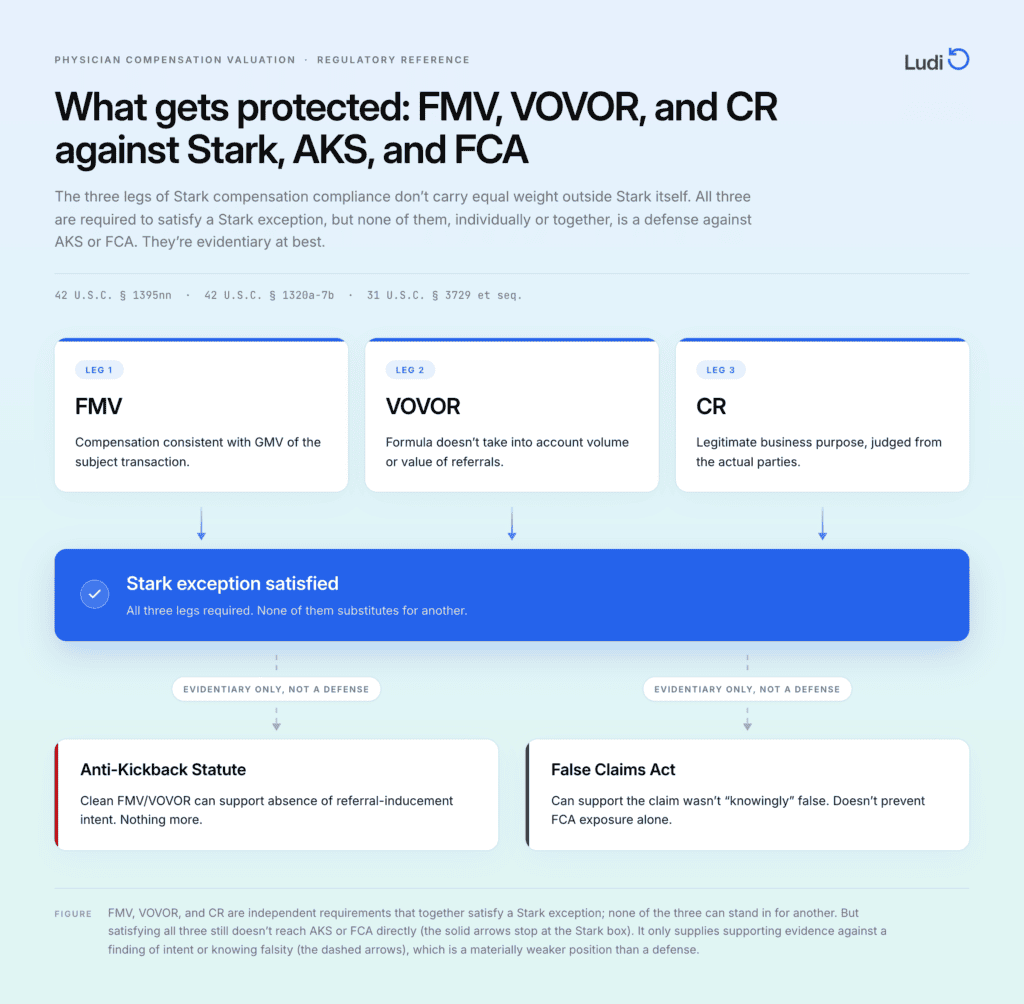
A fair market value opinion covers one of three requirements for a Stark Law exception. Fair market value, commercial reasonableness, and the volume-or-value standard function are the three cornerstones of most Stark Law compensation exceptions. Picture them as a three-legged stool. An FMV opinion only speaks to the first leg, but many health systems assume it covers all three. As a result, their compliance structure ends up resting on a single leg, with the FMV opinion doing the work of three.
This three-legged stool also stands on a foundation that has nothing to do with valuation: the arrangement must be documented, it must describe the services covered, compensation must be set in advance, and some exceptions even require a minimum term. In practice, these procedural requirements are where arrangements fail most often, and an FMV opinion speaks to none of them.
What does each leg of Stark compliance require?
- Fair market value (FMV). Since 2021, FMV means the value in an arm’s-length transaction is consistent with the general market value (GMV) of the subject transaction. For compensation, it’s what well-informed parties who aren’t in a position to generate business for each other would agree to through bona fide bargaining.
- The volume or value standard (VOVOR). This asks whether compensation is determined in a manner that takes into account the volume or value of a physician’s referrals, or other business generated between the parties. Since 2021, CMS applies an objective test built around whether the compensation formula includes referrals or other generated business as a variable.
- Commercial reasonableness. This asks whether the arrangement furthers a legitimate business purpose and is sensible given the characteristics of the parties, including their size, type, scope, and specialty. CMS has been explicit that an arrangement can be commercially reasonable even if it doesn’t result in a profit.
CMS decoupled these three tests in its 2021 final rule, pulling the volume or value language out of the definition of fair market value, where it had previously sat. They now stand independently, and satisfying one says nothing about the other two.
Infographic: The Three Legs of Stark Law Compensation Compliance
Download this infographic as a PDF.
Does an FMV opinion protect you against the Anti-Kickback Statute and the False Claims Act?
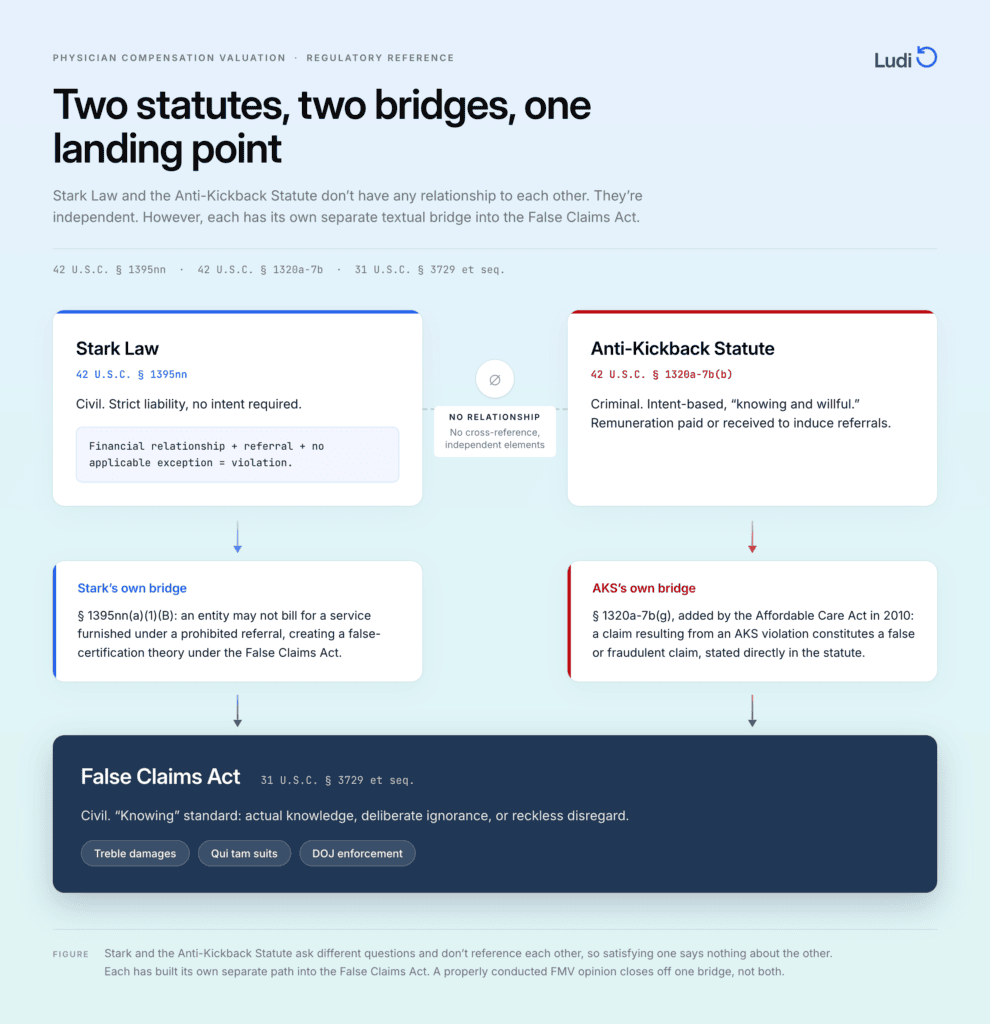
No, not necessarily. Stark is a civil, strict-liability law where a violation doesn’t require intent, while the Anti-Kickback Statute (AKS) is criminal and turns entirely on intent. Either party to the exchange violates AKS by knowingly and willfully paying or accepting remuneration intended to induce referrals. AKS violations carry criminal exposure, plus civil monetary penalties, and exclusion from federal healthcare programs.
Stark exceptions are mandatory. An arrangement either fits squarely within one or the referral is prohibited. AKS safe harbors are voluntary, so falling outside one doesn’t make an arrangement illegal. It means regulators evaluate it case by case, on the totality of the circumstances.
Stark failure is clear-cut: you’re either in compliance or you’re not. Falling outside an AKS safe harbor is murkier, and it comes down to judgment. Both statutes can create False Claims Act (FCA) exposure, with its treble damages and whistleblower suits.
In 2010, the Affordable Care Act amended the AKS to add language stating that a claim for items or services resulting from an AKS violation “constitutes a false or fraudulent claim” under the FCA. That single sentence removed the need to prove a separate false certification, and a whistleblower or prosecutor must only establish the underlying AKS violation.
Worth flagging that the “resulting from” language is still being contested, and courts are split on how tight the connection between the kickback and the claim needs to be.
Stark reaches the FCA less directly, through claims submitted for referrals tainted by a financial relationship that fails to meet an exception. So, if you’re relying on an FMV opinion, it can help show you didn’t intend to induce referrals, but it isn’t a complete defense.
Worth flagging that the “resulting from” language is still being contested, and courts are split on how tight the connection between the kickback and the claim needs to be. The First, Sixth, and Eighth Circuits now require proof that the kickback was the but-for cause of the claim, a meaningfully higher bar for the government and whistleblowers to clear. The Third Circuit requires only a looser causal link. The Supreme Court hasn’t weighed in, so the standard you’re held to can depend on where a case is filed.
Infographic: Understanding Stark Law and the Anti-Kickback Statute
Download infographic as a PDF.
What assumptions are FMV opinions built on?
Any FMV opinion is designed to match a specific set of services for a particular physician arrangement. For clinical services, work hours and productivity are the largest clinical inputs, weighed differently in hospital-based and coverage-heavy specialties. Administrative and medical directorships are measured by documented hours and the scope of the services/expertise involved. On-call work depends on frequency of call-back, degree of restriction (i.e. leave town or drink while on call), and how scarce that specialty’s coverage is in the market.
Why are accurate work RVUs a fair market value issue?
Work RVUs (wRVUs) are a fair market value issue because an FMV opinion is only as good as the data underneath it. Nearly every clinical compensation model gets benchmarked against national survey data by mapping a provider’s wRVU volume and their dollar per wRVU rate ($/wRVU) to percentiles, and the opinion typically concludes the arrangement is at fair market value if those percentiles reasonably line up.
That exercise assumes the wRVU count going in is correct. Coding errors, documentation gaps, and inconsistent split-billing credit with APPs can all push wRVU totals up or down without any real change in clinical work. A provider who’s over-coding can end up looking properly paid for production that isn’t real, which is exactly the pattern regulators scrutinize when compensation appears tied to referral volume instead of legitimate productivity.
If the wRVU data is wrong, the FMV opinion’s conclusion is wrong too, no matter how clean the report looks or how rigorous the methodology was on paper. Since FMV is one of the conditions Stark exceptions require, a flawed wRVU dataset can undermine the entire compensation exception. Auditors and regulators test the underlying productivity data directly.
Is being below the 75th percentile enough to prove a rate is fair market value?
No, and CMS has said so directly. In the 2021 final rule, CMS wrote that it was uncertain why commenters believed it was agency policy that compensation at or below the 75th percentile is always appropriate, or that compensation above it is suspect.
Percentiles aren’t interchangeable across metrics, and treating them like a single risk dial misses what’s actually being measured. A percentile can describe a rate, volume, or total compensation. A physician at the 90th percentile for total pay isn’t automatically overpaid; they might simply be at the 90th percentile for wRVUs with a perfectly median $/wRVU rate. Conversely, a $/wRVU rate that sits comfortably within the range of market data can produce compensation well outside any reasonable range once you apply it to production at the 90th percentile of volume.
The rate is the input you’re supposed to be testing for fair market value. Total compensation is the output, and it moves with volume regardless of where the rate itself falls against survey data.
Can an FMV opinion become outdated, and if so, how often should you revisit it?
Yes, an FMV opinion can become outdated, because it’s a point-in-time snapshot based on the facts at the date of the valuation. Many healthcare organizations get an opinion on the front end to guide contracting, but material terms can change during negotiations such that the final agreement no longer matches the deal that was valued.
Review the FMV opinion again before a physician or clinician signs a new agreement. That confirms the final negotiated deal still matches the assumptions the FMV opinion was based on.
Post execution, it’s still important to monitor whether the assumptions within the FMV remain valid. Consider an event-based review schedule. Take a second look at your FMV opinions whenever there are material changes to a physician’s staffing schedule or productivity. The same goes for market-wide shifts, such as major fee schedule coding changes.
Is a point-in-time opinion enough, or do you need continuous monitoring?
A point-in-time FMV opinion supports compliance, but it only captures the moment a contract was signed. Continuous monitoring does more, because it lets you track three things a scheduled review can’t catch in real time:
- Risk scoring. Continuous monitoring makes it easier to determine how exposed each physician arrangement is. A physician paid a flat dollar per wRVU carries more risk from a productivity swing than one on a straight salary, because every additional wRVU moves total compensation directly, with no ceiling built in.
- Guardrails. With continuous monitoring, you can set thresholds for your most exposed physicians. If productivity metrics cross a certain threshold, it triggers a review to confirm the arrangement still matches the FMV opinion, rather than waiting for the next scheduled cycle to notice.
- Specialty-level flags. Sometimes productivity changes affect an entire specialty at once, instead of an individual provider. Flagging groups, such as OB/GYNs after a coding change or a shift in call coverage, lets you address the whole group together instead of reviewing each contract one at a time.
Continuous monitoring can’t replace an FMV opinion, but it can catch productivity changes between scheduled reviews, so you don’t end up overpaying or underpaying a physician for months without knowing it.
What should you ask before you renew an FMV opinion?
Before renewing an FMV opinion, run through a short list of questions:
- When did the physician last receive an FMV opinion?
- What’s your organization’s FMV review cadence, if you have one?
- Have there been any contract amendments since the last FMV opinion, and if so, were they reflected in an update?
- Have any core assumptions, duties, or arrangement terms changed that could conflict with the current FMV opinion?
Rubber-stamping a renewal because the last opinion is on file isn’t the same as confirming the opinion still applies.
Should you review FMV opinions in-house or bring in outside help?
Getting and maintaining FMV opinions is a core part of managing physician compensation. Some organizations handle it in-house, while others partner with outside consultants.
Getting the opinion in the first place belongs in the hands of a qualified valuator. Once you have your FMV and you need to assess whether your arrangement has panned out in a manner consistent with the opinion, an advisor who’s worked inside valuation firms and alongside health systems brings a useful vantage point from both sides of that table.
Ludi doesn’t issue FMV opinions, and we’re not tied to any consulting firm. What we can do is run the compensation your FMV opinions are based on and flag problem areas, since that’s often where drift shows up first. Interested in learning more about our Strategic Services? Contact us here.